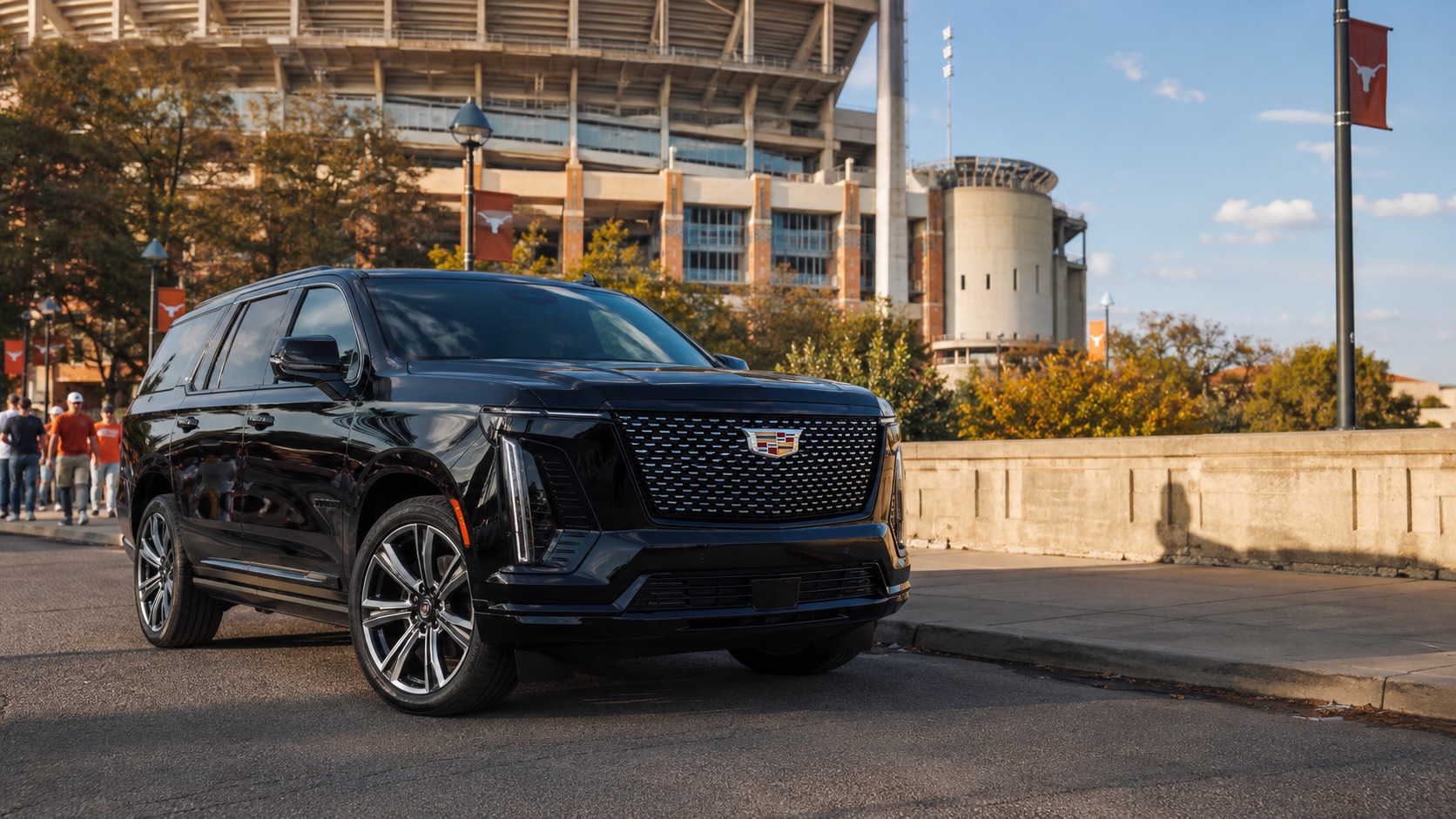
There is a moment, somewhere around the third quarter of a Longhorn home game, when a certain kind of fan stops watching the field and starts watching the clock. Not the game clock. The other one. The one that tells them how long it will take to get out of the parking garage on San Jacinto if they leave now versus if they stay to the end.
If you have ever left a game early to beat traffic, you have paid for a ticket you did not fully use. We drive Austin on game days for a living, and we can tell you that the fans who stay through the final whistle, through the alma mater, through the whole thing, are almost always the ones who did not drive themselves.
This is a guide to how game day transportation actually works around Darrell K Royal-Texas Memorial Stadium — what makes it harder here than at most college venues, why the obvious solutions break down on exactly the days you need them, and how a chauffeured SUV changes the shape of the day. Some of this is practical advice you can use whether or not you ever book a car with us.
Why Game Day in Austin Is Harder Than It Looks
Most big college football stadiums sit on the edge of town, ringed by parking lots measured in acres. You drive in from the highway, you park on grass, you walk ten minutes, and afterward you sit in a field until the line moves.
DKR is not that. It sits in the middle of a working university campus, a few blocks from the Texas Capitol, wedged between I-35 and the heart of central Austin. On a home Saturday, a venue that seats just over 100,000 people drops that crowd into a neighborhood grid of surface streets that were never designed to absorb it.
Three things compound the problem:
- The street closures. Roads immediately around the stadium close to general traffic on game days. The exact footprint varies by kickoff time and event schedule, but the practical effect is constant: the closer you try to drive to the stadium, the more likely you are to hit a barricade and get routed somewhere you did not want to go.
- The I-35 factor. The corridor running past campus has been under sustained construction as part of the Capital Express project. Lane configurations and ramp access have shifted repeatedly. A route that worked last season may not work this one, and navigation apps are frequently a step behind the cones.
- The event layer. Game day is not just a game. Bevo Boulevard turns San Jacinto into a pedestrian fan festival for hours before kickoff. Longhorn City Limits brings a concert stage to the LBJ Lawn. These are genuinely great, and they also mean thousands of people on foot in the exact places cars would otherwise move.
Add a night kickoff, when the crowd has had all day to arrive and downtown's own Saturday night is layered on top, and you have one of the most difficult driving environments in Texas.
The Parking Math Nobody Runs Before Kickoff
Fans tend to think about parking as a single number: the price of the space. The real cost has four parts, and only one of them is the fee.
Finding it
Campus garages near the stadium — the San Jacinto, Brazos, Trinity, and Manor garages among them — sell out, and permitted lots are frequently reserved for donors and pass holders on game days. Availability and pricing change season to season, so anything you read on a message board from three years ago is unreliable. What does not change is the pattern: the good spots are spoken for well before you start looking.
Getting to it
Arriving two hours early is not caution, it is the actual requirement if you want a space near campus without stress. That is two hours of your Saturday spent circling, not tailgating.
Leaving it
This is the part that hurts. A garage that took eleven minutes to enter at 10 a.m. can take upward of an hour to exit after the final whistle, because everyone in it is trying to leave through the same ramp at the same moment, into streets that are still closed to through traffic. You are not stuck in traffic. You are stuck in a building, waiting for permission to join traffic.
What it costs you
Two hours early plus an hour to escape is three hours of your day surrendered to the logistics of a car you are not even in for most of it. For a family driving in from Round Rock or Georgetown, that is the difference between a fun day and a long one.
Why Rideshare Breaks Down on Exactly These Days
The obvious answer is to skip parking entirely and use an app. On an ordinary Tuesday, that works fine. Game day is where the model strains, for reasons that are structural rather than bad luck.
- Surge is at its worst when demand is most concentrated. A hundred thousand people wanting a ride within the same twenty minutes is precisely the condition surge pricing is built to respond to. The ride home routinely costs several times the ride in.
- The pin does not work. With streets closed and GPS drifting between tall buildings and dense crowds, your dropped pin and your driver's map often disagree. The result is the familiar game-day scene of two people on phones, walking in circles, describing landmarks to each other.
- Cancellations spike. Drivers who accept a ride, then see the traffic they would have to enter, cancel. You go back into the queue at the end.
- Nobody is holding your spot. An app driver is not waiting for you. They are matched to you at the moment you request, along with everyone else requesting at that moment.
The common thread: rideshare allocates a car to you after you need it. On the one day of the year when supply is overwhelmed, that ordering is exactly backwards.
How Chauffeured SUV Service Actually Works on Game Day
A pre-arranged black car reverses the sequence. The vehicle is assigned to you before the day starts, and it stays assigned to you. That single difference solves most of what goes wrong above, but the execution matters, and it is worth knowing what good execution looks like.
The pickup point is chosen, not guessed
We do not try to reach the stadium gates. Nobody can. Instead, your chauffeur identifies a pickup point a few blocks outside the closure ring — on a street that stays open, and, just as importantly, that flows in the direction you are ultimately heading. Getting picked up on the wrong side of the stadium can add half an hour before you have gone anywhere.
You get that exact corner by text before kickoff, with a landmark you can find in the dark and in a crowd. A short, pleasant walk to a car that is genuinely there beats a long wait for a car that might be.
The driver absorbs the timing problem
Your chauffeur is watching the game clock and the traffic feeds so you do not have to. When a game is heading for a blowout, they will often reposition early. When it goes to overtime, they wait. You text when you start walking, and the car meets you.
Hourly service keeps the day whole
For most game day groups, hourly as-directed service is the right structure. The same chauffeur and the same vehicle stay with you for the day. That means the cooler goes back in the SUV after the tailgate instead of being carried into the stadium or abandoned. It means the jackets nobody wanted at a 2:30 kickoff are in the car when the temperature drops. It means dinner afterward is a decision you make at the time, not one you had to commit to in advance.
Point-to-point transfers are the cheaper option if you only need a ride in and a ride out. Both are legitimate. The hourly version is what people book once they have done it the other way.
Choosing the Right Vehicle for a Game Day Group
Game day groups reliably underestimate their own volume. The passenger count is easy to get right. The stuff is what surprises people.
- One to three passengers — an executive sedan is comfortable and the most economical choice, well suited to a couple heading in from downtown or a pair of season ticket holders.
- Four to six passengers — a luxury SUV. This is far and away the most requested vehicle for Austin game days, and for good reason: the cargo area handles chairs, coolers, and layers without anyone holding a bag on their lap.
- Seven to fourteen passengers — a passenger van, which is what alumni groups, corporate suite parties, and multi-family outings end up in.
If your group sits right on the boundary between two sizes, size up. The marginal cost is modest and the difference in comfort over a long day is not. You can see capacities and specifications for each vehicle on our Austin luxury SUV and black car fleet page.
A Game Day Timeline That Actually Works
This is the shape of a well-run home game Saturday for a group of six, built around a mid-afternoon kickoff. Shift everything for a night game, but the intervals hold.
- Four hours before kickoff — Pickup at your home or hotel. Nobody has driven, so nobody is negotiating who stays sober or who circles the block. The day starts in the right mood.
- Three and a half hours before — Drop at the tailgate. Your chauffeur unloads the cooler and the chairs at the curb rather than a quarter mile away in a garage.
- Ninety minutes before — If you want to see Bevo Boulevard properly, this is the window. The car takes the gear you no longer need back with it.
- Forty-five minutes before — Walk to the gates. Clear bag policy applies at DKR, so anything that does not comply goes back to the vehicle rather than to a trash can outside the gate.
- During the game — Your driver stages nearby and monitors the clock.
- Final whistle — Stay. Watch the alma mater. Let the first wave go. The people sprinting for the garages are about to sit still for an hour.
- Twenty minutes after — Text your chauffeur and walk to the pre-arranged corner. By the time you are moving, the worst of the surge has passed and the closures have started to lift.
- Afterward — Dinner downtown, drinks on Rainey, or straight home. On hourly service this is a decision, not a logistics problem.
Flying In for a Game
A significant share of a DKR crowd does not live in Austin. For visiting fans, alumni coming back, and families following an SEC road schedule, the transportation question starts at the airport rather than the stadium.
The pattern we run most often is a three-part weekend: an airport pickup at Austin-Bergstrom on Friday, hourly service Saturday covering the tailgate and the game, and a return transfer to AUS on Sunday. Flights are tracked in real time, so a delay in Dallas does not turn into a missed pickup in Austin.
One practical note for visitors: Austin hotel rates and availability move sharply on home game weekends, and the same is true of vehicles. If you are coming in for a marquee opponent, book the room and the car in the same sitting. People reliably do the first and forget the second.
Tailgates, Alumni Events, and the Corporate Side
Game day is a business day for a lot of Austin. Companies host clients in suites. Firms run alumni events at hotels downtown before shuttling groups to campus. Recruiting weekends put visitors in vehicles for two days straight.
Those bookings have a different shape than a family outing. They usually involve multiple vehicles moving on a coordinated schedule, a named point of contact who is not a passenger, and consolidated billing rather than six people splitting a check. If that describes your weekend, our corporate and executive travel service is built for it, and it is worth a phone call rather than a web form so we can map the movements properly.
Night Games Change the Calculation
A night kickoff is a different animal. The crowd has had the entire day to arrive and to enjoy itself. Downtown Austin's regular Saturday night is running concurrently, which means the postgame surge collides with the bar-close surge a few hours later. Temperatures drop more than visitors expect once the sun goes down, even in September.
Two adjustments are worth making. First, plan on hourly service rather than point-to-point — the value gap widens at night, because the return ride is the one that gets expensive and unreliable. Second, put the layers in the car. A chauffeured vehicle is, among other things, a climate-controlled closet that follows you around.
What It Costs and How Booking Works
Game day pricing follows the same structure as the rest of our work: flat rates for point-to-point transfers, hourly rates with a minimum for as-directed service. Hourly minimums are longer on game days than on ordinary Saturdays, because a vehicle committed to your group is genuinely unavailable to anyone else for the duration.
For a solo fan, a chauffeured SUV is a premium over parking. For a group of four to six, the arithmetic tightens considerably once you count a garage fee, surge-priced rides in both directions, and the real possibility of needing two vehicles. Split six ways, the per-person figure often lands near the cost of two surge fares — with the difference that your price is fixed at booking rather than set by demand at the exact moment you are most desperate.
To book, use the online reservation form or call (512) 332-9910. For game days we will ask for your kickoff time, your group size, whether you are tailgating, and your postgame intention, because those four answers determine the vehicle and the structure. Every reservation is confirmed in writing with your chauffeur's name and direct number before the day arrives.
Booking Windows, Honestly
Two to three weeks ahead is comfortable for a typical home game. For a marquee SEC opponent, a rivalry weekend, or a night kickoff, book when the date lands on the schedule and do not wait for the kickoff time to be announced.
That last point is worth dwelling on, because it catches people every year. Kickoff times are frequently confirmed only about twelve days out. Fans wait for the announcement before booking anything, which funnels an entire stadium's worth of planning into the same narrow window. The vehicles are gone before most people start looking. Reserve the car first; the time can be adjusted once it is set.
The Real Argument
The case for a chauffeur on game day is not fundamentally about luxury, though the vehicles are nice. It is about what you are actually buying with a football ticket.
You are buying a day — the tailgate, the walk in, the crowd noise, the fourth quarter, the alma mater afterward. Driving yourself means paying for that day and then handing back three hours of it to parking logistics, plus the low-grade attention tax of thinking about the exit while the game is still going.
Everyone in the group gets the same day. Nobody is the designated driver. Nobody is watching the clock in the third quarter. That is the whole product.
Hook 'em.